Happy New Year. Let’s all have a great 2017 and say good riddance to 2016!
But before I can do that, I am going to explain the trees I selected for the Ecological Backyard Design I showed in November.
If you remember, I left off explaining the evergreens I used in the design.

Before we look at the trees used, lets review some of our goals for this design. As you will see, most of our goals will be met using the trees selected. This includes the following:
DESIGN GOALS
(A) Supporting pollinators by providing native flowers – Four smaller flowering trees do this, even the one non native!
(B) Including top host plants for native insects – We have the #1 species of tree as well as several other in the top ten.
(C) Providing food and shelter for birds and small mammals – ALL of these trees do this.
(D) Sequestering carbon from the atmosphere into the soil & long lived trees – The two species of shade trees used are among the best and sequestering carbon from the atmosphere for several hundreds of years.
(E) Requiring low water and virtually no fertilizer inputs – No fertilizer should ever be needed and most will never require any supplemental water after established.
(F) Lowering the embedded energy of the materials used – Several of these trees are best planted as smaller specimens. This requires less energy to be used in their production as well as shipment and installation. Sure we could plant smaller sizes of any tree, but the shade trees need to be planted small and the redbud will grow so fast there is no reason to not plant it small.
Smaller Deciduous Trees
Now lets look at the Smaller deciduous trees.
These are going to be heavy hitters for the Spring and Fall seasons with flowers and Fall color. They are also going to attract birds to our backyard in a big way.
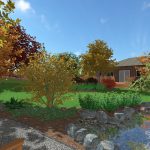
Here is how they are arranged in our design:

I have written about some of these trees before, but here is a quick breakdown of why I selected these trees:
Eastern Redbud
This 20 foot tree is woodland native to much of the country. It is best known for it’s early Spring purple – pink flowers that open on bare branches.
What is not so well known is that the flowers attract attract hummingbirds and butterflies. Cedar waxwings and Cardinals will also eat the buds and flowers (don’t worry they don’t eat much. They eat like a bird!)
In the winter the seed pods feed chickadees and titmice and woodpeckers love the insects that hide in the bark.


Serviceberry (Amelanchier sp.)
Both of the serviceberry have great early Spring white flowers on bare branches. They are earlier than the redbud, so you get an extended display of flowers.

The flowers attract pollinators and the early Summer tasty fruit feeds more birds than I can list. Make a deal with the birds and let them eat the ones you can’t reach!

Over 120 different species of caterpillar feed on the foliage, but don’t worry you won’t get them all. They rarely eat enough to even notice they are there.
Native insects and plants have had tens of thousands of years to figure out how to coexist (we could learn something from them). This is unlike exotic pests like gypsy moth caterpillars that will completely defoliate trees.
Plus those birds feed those caterpillars by the hundreds a day to their young, so they help limit the damage any caterpillars do. I found this video on Youtube for those of you who don’t believe me!

See my post Would you want a 70 foot statue in your yard for more info.
American Hornbeam
The American hornbeam is a native understory tree that grows in sun or shade just fine. New leaves emerge reddish then change to dark green. In the Fall they turn a collection of yellow, orange and red. The tree’s blue-gray bark resembles a well toned muscle adding great winter interest.
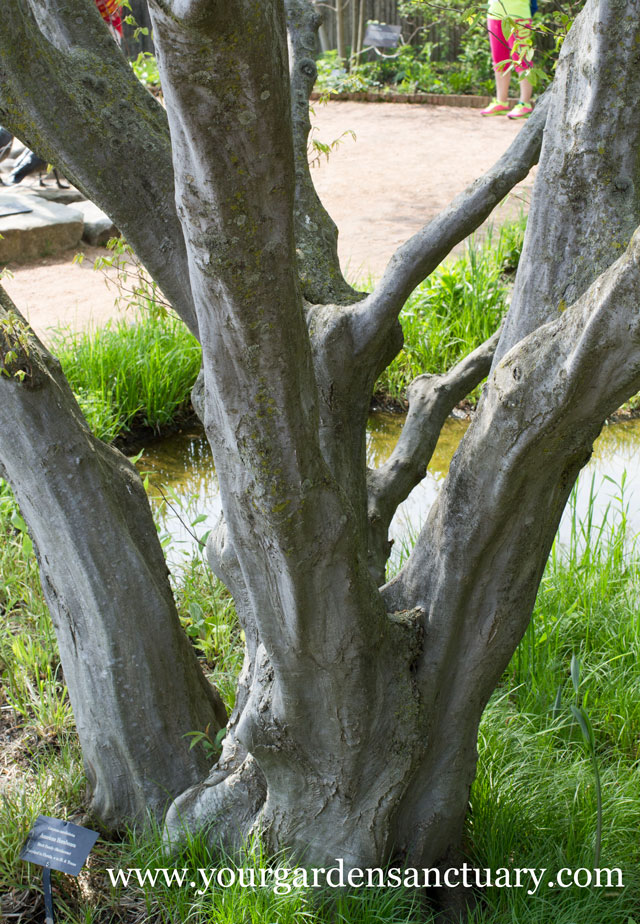
It is a great tough underused native landscape tree. The only reason nurseries don’t push it more is because it is slow growing and thus they can make more money selling you an inferior non native tree that can be grown much quicker.

Pink Princess™ Crabapple
The last of the small trees is a non native flowering crabapple.
Nonnative apple trees are an exception to the “natives are better than non natives” rule that I have come to accept. This is due to them being closely enough related to the few native apples that wildlife can and do eat them (according to Bringing Nature Home by Doug Tallamy) .
They are also not invasive like Ornamental Pears for instance, so you don’t have to worry about them spreading into natural areas and out competing native plants.
You do have to pick good disease resistant crabapple or you will regret it.
Pink Princess™ has excellent disease resistance and you guessed it, pink flowers. Birds also find the small, persistent in the winter, fruits quite tasty. This tree will bloom after the Redbud to further extend the Spring bloom season. Click Here for more info on this great little tree.
Shade Trees
Now lets take a quick look at the two types of shade trees we added. They are both slower growing and longer lived trees.
White Oak
The state tree of Illinois, the White Oak (Quercus alba) really can’t be beat where it can grow well. Oaks are the best genus of trees for wildlife in the US. I also really like the Fall color of white oaks. I have seen some White Oaks with Fall colors that I prefer over Sugar and Red maples.
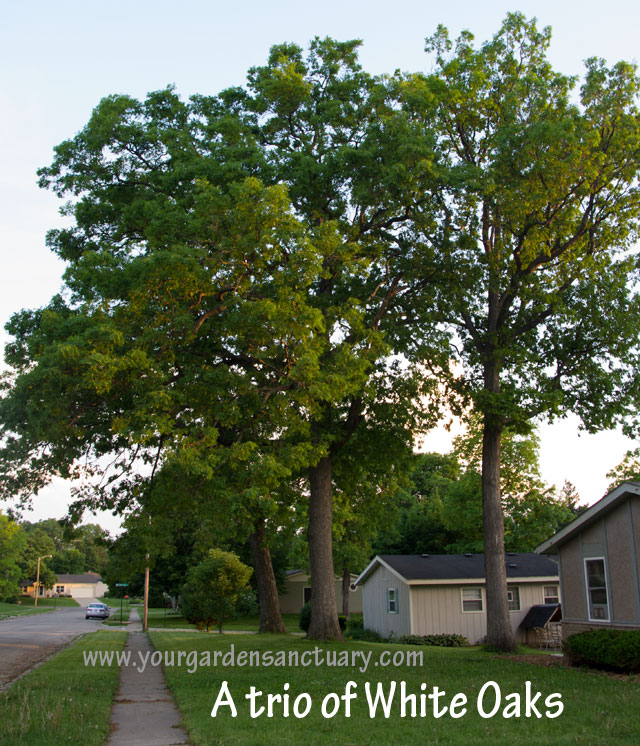
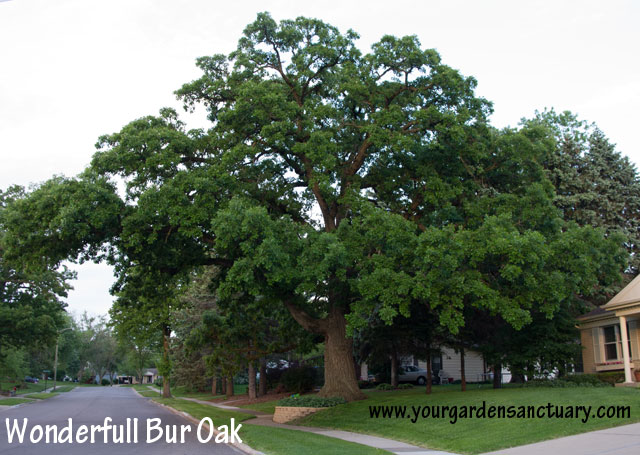
If the soil is dry and more alkaline then a White Oak prefers, choose a Burr (Quercus macrocarpa) or Chinkapin Oak (Quercus muehlenbergii). These two are great choices that can handle more urban and alkaline soil situations than white oaks but are still fabulous native shade trees.
Shagbark Hickories
We also have two Shagbark Hickories planted on the left side of the design. These will be small trees that won’t add much to the design when they are planted, but like the Oak will do their part to sequester carbon, feed wildlife and provide shade for the next couple of hundred years if we are lucky.
The Shagbark hickory (Carya ovata) is without a doubt, one of my favorite trees. It has awesome shaggy bark, hickory nuts I can eat, and very nice golden Fall color. Plus it attracts lot of squirrels for me to shoot at with my slingshot, just kidding!
I am not kidding when I say it does regularly feed Red squirrels, Gray squirrels, Raccoons, and Chipmunks. It can also attract gray and red foxes, rabbits, and bird such as mallards, wood ducks, and wild turkey. Hickories also support 200 species of native caterpillars per Doug Tallamy.
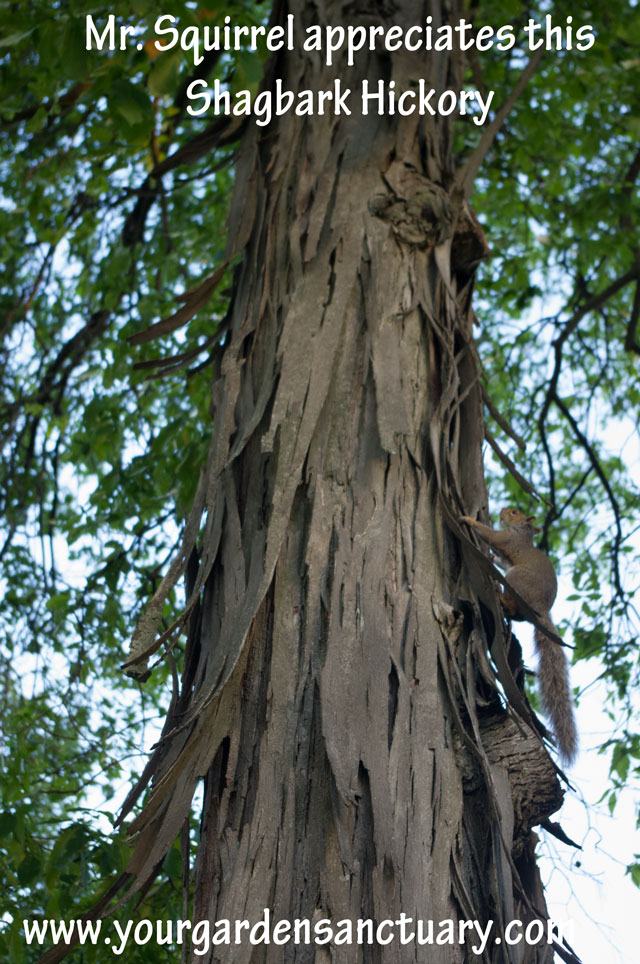
Shagbark hickories are damn near impossible to transplant so they pretty much never available at nurseries. They grow about an 1 inch or two the first year if planted from seed. The reason they are so hard to transplant and grow so little is that they are spending all of their energy growing a very large deep taproot.
You can occasionally get them conservation district sales in the spring, as 1-2′ tall transplants. Even then, though I would suggest planting several as odds are iffy if they will make it.

The good news is that in this design, we have enough other trees, that these are not really needed in the design and can be a gift for future residents to enjoy. Plus planting a tree from seed or a small seedling and watching it grow is a something everyone should experience.

That wraps ups the trees in this design. I may come back and explain the shrubs and perennials later, but if I do it won’t be next time. Next time, I will be writing about native groundcovers that beat the plants off of Vinca and Pachysandra!


Joe Hoy says
January 9, 2017 at 8:39 pmJim,
I live in the Denver metro area of Colorado. Which trees in your post above would deal with our diverse and many times crazy climate?
Thanks,
Joe
Jim says
January 12, 2017 at 2:24 pmHmm, your climate is vastly different then Chicago.
First off, none of them are native to your area so you might be better off with some local species.
That being said, I think the Bur Oak and American Hornbeam might be OK in your area.
That crabapple should also do well in a garden setting.
If any are appealing, I would see if they are sold in your local nurseries.
If they are not used in the trade, I would think they might be iffy for you.
PE says
January 17, 2017 at 11:15 amI must comment that Yew plants are extremely toxic to deer, elk, dogs and cats, even people (think children). This winter our area is experiencing deepest snow in 30 years forcing wildlife into urban yards for food. A small herd of seven elk died within minutes of browsing on yew plants in front yards. Fish & Game advised homeowners to immediately remove any yew plants they have to prevent further tragedies. Please be careful when selecting plants and be aware of the toxicity of any landscape plants you put in your yard! Thanks for a truly lovely garden design.
Jim says
January 18, 2017 at 5:02 pmYes, Yew are extremely toxic to most mammals, although most have the sense to stay away from them.
As many a homeowner knows, White-tail deer don’t seem to be bothered by them much.
If you are in elk country or have children that like to chew on plants I would either substitute another conifer or another entirely different type of plant.
There are definitely replacements but most such as boxwood (and most broad leaf evergreens) are also toxic, although perhaps less so.
This site will be sunny enough till the trees grow in to recommend dwarfs of conifers such as hemlocks (which can tolerate a good amount of shade) and dwarf white pines (can handle a bit of shade) as replacements for the yews.
Blue Shag White Pine is a nice one that could be used and is readily available in my area at least.
Monja says
February 15, 2018 at 3:22 pmHi,
Could you tell me the dimensions of this backyard? Beautiful design.
Monja says
March 16, 2018 at 7:42 pmLovely design. Did you ever followup with a post on the shrubs and perennials used in this plan? I can’t seem to find it if you did.