It is conference season in the "green" industry and I have been busy at both as an attendee and a vendor. Before I go to another one and get even more ideas, I wanted to share one. This fabulous one, I picked up from native plant icon Gerould Wilhelm from a talk he gave with plantsman Roy Diblik.
Before I share it, let me give a bit of background from Gerould's talk.

Why most trees are really lonely
To simplify Gerould's talk too much, let's say the jest of it was that plants live in communities in the wild and should also in urban and suburban plantings.
Why you might ask?
There are too many reasons to list them all here. One reason though is that a part of the roots of wildflowers and other plants that are found in the forest with trees die each winter. This root death adds organic matter to the soil. Don't worry about this as only parts of the roots die and they grow back throughout the year. Consider also that the roots of these plants unlike turf grasses and most non-native ornamentals extend deep into the soil.
These dead roots are a form of organic matter that with the help of microorganisms, begin to decompose in the spring. This decomposition process releases CO2 and water into the soil.
The decomposition of dead roots releases moisture into the soil, giving the trees that grow in that soil access to water even during spring droughts. These decomposed roots also leave channels for needed air and water to flow to the tree's roots.
If you were a tree which would you prefer?
- Being a tree living as part of a community with other plants where it gets watered even when no rain comes versus.
- Being a tree planted by itself in a ring of shredded pallets and shallow-rooted lawn that often form a barrier to rain and air exchange.
Now beyond Gerould's talk, if you also consider what we know about how trees in the forest and woodlands communicate and even nurture each other, we can begin to really feel sorry for the typical suburban tree. On a side note, The Hidden Life of Trees for is a must read for anyone that wants their mind blown by what is happening in the woods right before our eyes.
The Big Idea
Ok, so what was Gerould's idea I was so excited about. Here it is:
- At your local elementary school, have the 1st graders go out and plant a native tree in the school grounds. Ok, maybe have them just watch that part unless they are particularly good with a shovel. But they have to be there and be involved.
- Before the tree was planted you should have had the grass removed in maybe a 3' diameter circle around the tree.
- Next, have the teacher and children plant small plugs or containers of native plants that associate with that plant in the wild around the tree. I would recommend 12"-18" spacing for most plants. You want these plants to TOUCH when they are fully grown and as I think I heard Roy say, "feel each other".
- Finally, have the kids spread shredded leaf mulch around the tree and gently water everything in. No wood mulch please, it actually suppresses perennial growth. Nobody spreads wood chips in the forest (well except for the occasional Beaver).
Fall would be a great time to do this so the plants would get well established before the next summer and thus should not need supplemental water then.
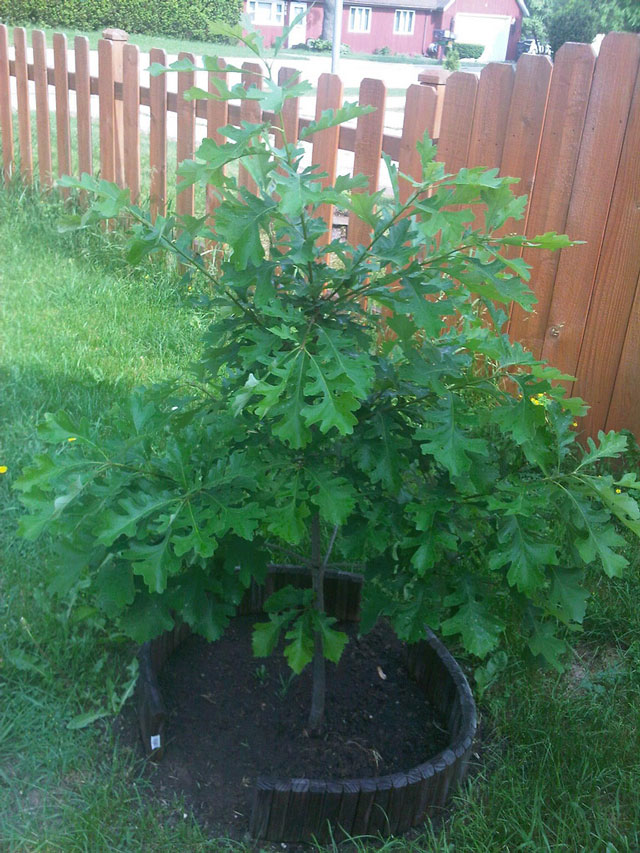
It does not end with the planting
In the Spring the teacher could use the tree and its plantings as an outdoor classroom to see how plants grow after the winter.
Then every year as the tree grew the children's next teacher could take them out and they could remove another foot of turf around the tree (or have the grounds crew do it ahead of time for them) and plant more native plants that associate with the tree. The planting would gradually grow larger and transform the school grounds.
By the time they get to 8th grade, they can show grandparents and other graduation visitors the tree they planted and took care off all of those years. Science, art, and even English classes could use the tree and its plantings in lessons. Maybe growing native plants from seeds to plant around the ever enlarging circle could be a project for 7th and 8th graders.
Perhaps the most transformative lesson imparted could be those life lessons about growing and caring for something those children were able to learn.
How many of them would bring back their own children one day to see the tree they planted when they went to school. They could show their children an example of all the great things they would get to do at school.
An Example
As an example, if you planted a Burr Oak (Quercus macrocarpa) you would want to plants that grow with it in natural plant communities.
These could include plants such as Wild Geranium (Geranium maculatum) and Jacob's ladder (Polemonium reptans), which are both spring flowering ground-covering perennials. You would also want to include grass-like plants such as Pennsylvania sedge (Carex pensylvanica) in the plantings.
As the tree grows and you expand the ring around it, you will want to add more species to diversify the planting. Maybe once our planting area gets big enough, we would even add some shrub species like American Hazelnut (Corylus americana). Researching and finding out what to add could be a class science project. Which plants survive and reproduce and which ones fade away as the shade of the tree increases? For more information on plant associates see my post, Using plant associates to find native plant ideas.


Tree Planting is not a one-time thing
While that is exciting enough, imagine if this was done with EVERY 1st-grade class. Now, what does that school grounds look like in 10 or 20 years?
You have turned it into a genuine woodland. One that supports wildlife, sequesters carbon, creates a calm restorative environment, and enriches the lives of both the students and teachers.
How many of those students would follow the lessons they learned from this experience and grow something of their own. Maybe they become a teacher or a scientist? What else could they have learned from those experiences?
Not only Schools
There is nothing stopping you from doing this in your own yard to mark the beginning of your child or grandchild's journey through school. You could make the Labor Day ritual to remove some grass and add to the tree's community. What kind of memories could that make?


_meant_to_be_a_large_parking_space..._-_panoramio.jpg)
Ariel says
February 22, 2019 at 6:55 amThis is a great idea. I’d been planning to do something like this with my street trees (Nyssa sylvatica, planted last October, currently about 2-3′ tall…tiny, but hey, my city gave them to me for free). How can I find out which plants both (a) associate with blackgum, and (b) will thrive in full sun?
Also, how close should the companion plants be to the tree, especially if the tree starts out small?
Jim says
February 22, 2019 at 11:15 amYour best bet would be to go to a quality nearby natural area that has sweet gums in their natural environment and see what’s growing with them. You could also ask a naturalist in your area or even pick up a book on native plants of your state.
Sweet gums are not native to my area and I am not sure where you are located, but if you want to dig into some of my detailed posts there are some great web resources that could help you. See my posts at https://www.yourgardensanctuary.com/land-cover-viewer/ and https://www.yourgardensanctuary.com/plants-for-your-nature-inspired-garden/
As far as how far to plant away from the tree. It will depend on what you are planting but probably about a foot would be fine in most cases.
Shane says
May 22, 2019 at 1:31 pmHi! I was hoping you could help clarify the zones you have listed for the various trees you provide info for in your articles. According to the USDA grow zone map I am in zone 8b (central TX area). From my understanding, the zone designations are based on the lowest temp that was recorded for that area over a given time. So, if I am in 8b, does that mean that I could plant a tree that you have listed as zone 4-7 since plants that are listed for that zone can handle colder weather than it gets in zone 8b, or am I not understanding your tree zone designation correctly? Your advice or links to sites with this info are greatly appreciated. Thank you!