On the last post, I wrote about finding Plant associations for a woodland inspired garden. I used my place as an example and found out that the woodland type near me was probably the plant association of White Oak – Northern Red Oak – Shagbark Hickory Glaciated Forest.
This is a good thing to know. With this information, we can find other native plants that would naturally be found in this plant association.
Before we find out some of those plants, let’s discuss the four layers of the forest so that we can organize these plants into categories. Doing this can help us find plants for different uses of a woodland inspired garden.
Four Layers of the Forest or Woodland
These four layers are:
- Canopy layer
- Sub canopy layer
- Shrub layer
- Ground layer

The Canopy is the top layer of a woodland. It is the dominant trees. These are the big trees that shade the layers below.
The Sub canopy is the next layer. It’s the middle layer of a smaller trees such as Redbud. It also includes younger canopy trees. These cast more shade on the layers below.
The Shrub layer contains woody plants with multiple stems such as dogwoods and viburnum. There are also seedlings of the taller trees here. Lots of birds and other animals live here.
The Ground layer is the floor. This is where you will find the wildflowers, ferns, grasses, creeping shrubs, and mosses. Many cannot take direct light.
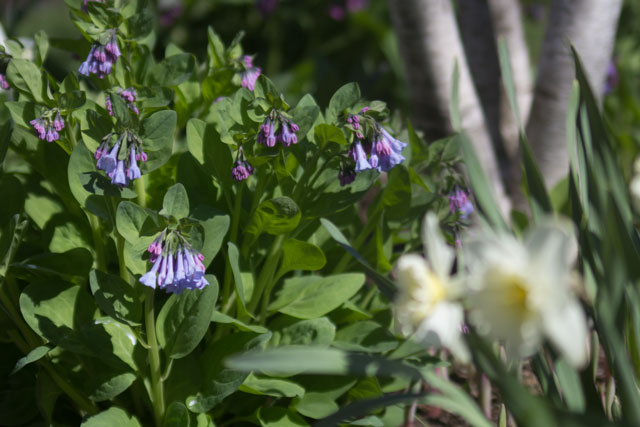
Another type of plants in the ground layer are the Spring ephemerals. These grow rapidly and bloom before the trees leaf out and shade them. My favorite are the Virginia bluebells (Mertensia virginica).
Plants for a Woodland Inspired Garden by Layer
Since I know the type of woodland that is in my area, I can look up what plants grow there. Some only grow in southern range of this type of woodland. An example would be Stiff Dogwood (Cornus foemina). It is native in Southern Illinois, but not in my area. It would, however, look at home in a landscape inspired by this type of natural area.
If you are looking to create a woodland inspired garden, it makes sense to include the native plants of that woodland.
Here are some of the plants, by layer.
The Canopy layer
- White Oak (Quercus alba),
- Northern Red Oak (Quercus rubra),
- Northern Pin Oak (Quercus ellipsoidalis),
- Bur Oak (Quercus macrocarpa),
- Black Oak (Quercus velutina),
- Shagbark Hickory (Carya ovata),
- Black Walnut (Juglans nigra).
The Sub canopy layer
- American hop hornbeam (Ostrya virginiana),
- Black Cherry (Prunus serotina),
- Sassafras (Sassafras albidum),
- Red Maple (Acer rubrum),
- Sugar Maple (Acer saccharum).
The Shrub layer
- Pagoda Dogwood (Cornus alternifolia),
- Flowering Dogwood (Cornus florida) (in its southern range not by me),
- Stiff Dogwood (Cornus foemina),
- American Filbert(Corylus americana),
- Virginia creeper (Parthenocissus quinquefolia),
- Eastern Prickly Gooseberry (Ribes cynosbati),
- Common Prickly Ash (Zanthoxylum americanum).
The Ground layer
- Tall Thimbleweed (Anemone virginiana),
- Heartleaf aster (Symphyotrichum cordifolium),
- Rattlesnake Fern (Botrychium virginianum),
- Pointed-Leaved Tick Trefoil (Desmodium glutinosum),
- Shining Bedstraw (Galium concinnum),
- Wild geranium (Geranium maculatum),
- Sweet Cicely (Osmorhiza claytonii),
- Common Black Snakeroot (Sanicula odorata),
- False Solomon’s Seal (Maianthemum racemosum).
What to do with these Plant lists?
Include them in your landscape design of course! From these lists, I could select a few plants from each group.
- Any of the Canopy trees would make fine shade trees. Although I would avoid Black Walnut (see my post Gardening around Black Walnuts for why).
- I could choose trees from the Sub canopy layer like the American hop hornbeam, Sassafras, Red Maple, or Sugar Maple as smaller shade trees.
- Pagoda and Flowering dogwoods could serve as small flowering trees.
- American Filbert and Eastern Prickly Gooseberry could be used as shrubs.
- Virginia creeper could be added to an existing large shade tree to give a touch of fall color.
- Wild geranium and False Solomon’s Seal could be added as very effective ground cover plants.
Of course, I am not limited to these plants. There are LOTS of other native and non native plants that I could add to invoke the feel of this specific type of woodland. For instance instead of the hard to transplant Rattlesnake fern, I might choose to use the elegant native to my area Maidenhair Fern (Adiantum pedatum).

photo credit: ellenmac11 via photopin cc
Think if every house in my neighborhood planted those native Canopy or Sub canopy trees instead of the usual Flowering Pears, Silver maples, etc. I imagine that my neighborhood would exude a sense of place that seemed to fit the landscape. I also imagine that the squirrels, birds and other wildlife would appreciate it.
In my next post, I will show you how to find what natural area types you are near. I will also show you how to find out what plants belong there and perhaps in your prairie or woodland inspired garden.


Bill Plummer says
June 21, 2014 at 11:37 amJim,
I live in the Corning New York area. The counties along the NY_PA border are called the southern tier and the northern tier respectively. Years ago I wrote an article for the local pqper entitled “The Southern Tier Tier Theory of Gardening. in which I descried the various canopies. Unfortuneately the paper edited out the second tier.
Bill